
How do you manage risk?
Assessing risk in a ship board environment was part of my role both when working for a flag State administration and as a company's safety and standards manager and DPA. I consider myself well placed to help you in the theoretical and practical development and implementation of risk assessments.
If you are a ship operator I can help you put together a risk management approach which suits your needs, fits into your safety management system and buys in your masters and crew members.
If you are an insurer or a lawyer wanting to check a company's risk management process I can provide you with the relevant analysis, i.e. verifying what is assessed, by whom, what documentation is available and how in general risks are dealt with in the company and on board.
Process
Risk assessments are to be carried out before nearly any activity is commenced on board or by a shipping company. The ISM Code asks for all identified risks to be assessed. The UK Merchant Shipping Health and Safety at Work Regulations in addition require a suitable and sufficient assessment of the risks of the health and safety of workers arising in the normal course of their activities or duties.
Risk assessments have as much to do with conviction and belief as they have to do with science. Some people follow Murphy's Law saying that anything that can go wrong will go wrong and others develop complicated matrices with or without factor or probability calculations. In the latter case the decision as to whether an action or job is safe to do is then just based on the calculated result.
Risks exist for various reasons. To determine them in a ship board environment would appear to require at least willingness, knowledge and competence to assess the particular situation. A risk could be the result of a misunderstanding and the different mental pictures the relevant actors have.
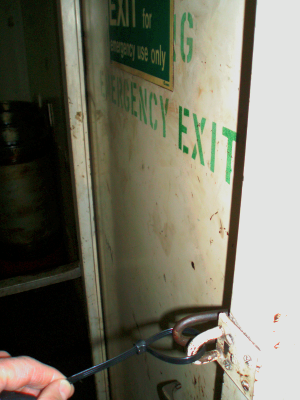
Which is a bigger risk (and for whom) damage, theft or non-compliance?
Numbers of uncertainty
Some people use matrix scoring methods but it is arguable whether they can deliver to owners, master and crew what they need to base their decision upon. Multiplying a(n) (estimated) factor for likelihood by a(n) (estimated) factor of severity may actually also multiply the uncertainty and thereby increase the error.
Risk assessments are inevitably procedures based to a smaller or larger extent on assumptions. Expressing risks in numbers gives them an aura of certainty or of scientific or mathematical accuracy which, however, does not exist. The calculation approach may work in finance where decisions may be based upon probabilistic computer calculations but not when the chief engineer has to decide whether the hot work on a tank bulkhead is safe. If it is not safe the ship will blow up irrespective of the calculated factor.
Without uncertainties risk assessments would not appear to be necessary in the workplace. If I knew, for example, that I am going to fall off a ladder I won't climb up in the first place (which, ok, is a risk assessment in itself but one without any uncertainty).
So, unless I have a crystal ball or a direct connection to higher authorities I may be left with a fair amount of guesswork.
Guesswork in itself is a risk as you may in the eyes of the law not have assessed all identified risks properly. The following example tells us a bit about how a judge may see an existing risk to determine a penalty or damages. The threat of a possible injury of an affected person and/or material or economic loss is in the end what drives the need for risk assessments on board.
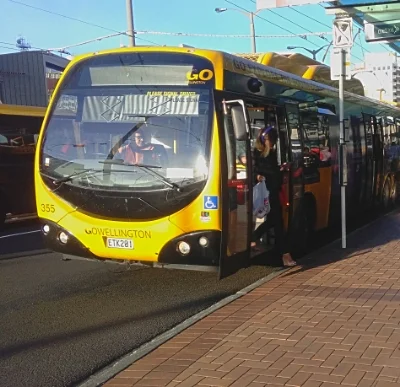
You are correct, this is a bus, not a boat; it is actually a Wellington trolley bus; they are lovely clean and quiet; why a bus? have a look at the text next to it
The issue with the bus
In 2015 in Wellington, New Zealand, I came across a High Court decision in a case which was brought by the New Zealand police against the Wellington public bus company. The police had evidence that during a four-month period passengers were entrapped eight times by the bus door when leaving the bus. However, nobody had been injured.
When the case went to court the judge said
"that means 7 million such trips during the four months period in which the eight incidents occurred. By any analysis the risk of entrapment that these numbers suggest is tiny compared to the company's overall passenger load".
That could have been the end of it but it wasn't because the judge went on saying that
"these numbers cut both ways however. The unique public safety dimension of this case compared with prior prosecutions under the Act is the sheer number of members of the public (untrained in workplace safety practice) who are exposed to the danger of entrapment". After including some discounts the Court arrived at a fine of NZ$ 31,650 for the company.
Using a matrix calculation approach would have suggested "a chance in a million". So, "get on with it".
That can potentially leave company, master or supervisor in the dock having to face criminal liability because of a, what a court may call it, negligent risk assessment.
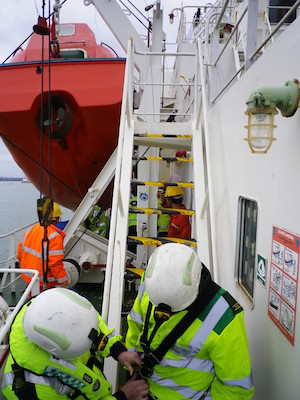
The risk, however, that something will go awfully wrong and the ship will be detained is not provided by the calculator; in this case the injured seafarer was hit by the lifeboat but was fortunately not seriously injured
More numbers to assess risks are used by both the Paris and Tokyo port State control MOUs. The Paris MOU even provides the ship risk calculator which you can use to determine whether your vessel is likely to be inspected when you arrive in the Paris MOU area. It does not tell you the likelihood of any detected defect, though...