
Who then needs support - and why from me?
The answer will depend on when it is asked and by whom. I have been a master mariner, flag State surveyor and manager in a shipping firm, to name but a few of my previous roles and I hold law degrees from German and English universities. Whether you are an owner, operator, insurer, lawyer or flag State my background and experience put me in a unique position to offer you a comprehensive service around questions of maritime hardware and operational compliance. I also have experience in organisational and staff development, maritime and environmental project management and even offer temporary staff substitution.

Pretty vacant and not just for lunch? Do you need help?
I can share my thorough understanding of how flag States go about matters of enforcement. The risk of non-compliance can be significantly reduced by means of ship inspections, awareness building and individual technical-legal coaching of senior company staff and ship's crew. Running mock surveys, health and safety and pre-port State control inspections as well as theoretical and practical inspection and awareness training can help to prepare ship, company staff, master and crew. I call this compliance management.
Another service I can offer for a short or medium term is to substitute for a vacant technical, operational or safety management position or the role of DPA.
On a more general note I can help you with maritime and legal research, training aspects, certificate of competency oral exam preparation or any merchant shipping related health and safety advice.
If you have a conflict in the workplace, a disagreement with a customer or any other stakeholder you can also approach me for a mediation service. In addition, I can facilitate your meetings if you need an independent and impartial person to do that.
If all goes pear-shaped and the vessel is detained, the options obviously become more limited. In such a case I can still help to verify that the port State control officer is not overstepping the mark and does not misinterpret the statutory requirements.
In case of a prosecution I could at least help to identify the correct facts, particularly if the solicitor and/or barrister do not have the necessary technical-nautical knowledge. However (see below), if it is a case of strict criminal liability the question of a guilty mind is irrelevant. In that case any mitigating circumstances may, however, still affect the severity of the penalty.
Civil and criminal liability rests with the company and master
Support, like risk, has different meanings to different people. For example, a clear and unbiased inspection report highlighting every defect and non-conformity might be seen as the basis for positive change. On the other hand it might be considered a barrier to continued commercial operation triggering unnecessary cost.
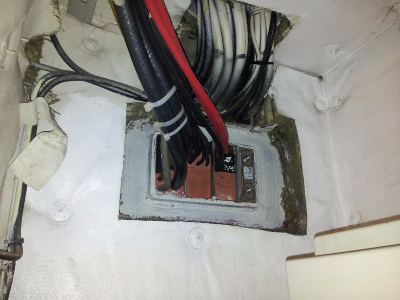
Structural fire protection missing - not picked up by either Class or flag State inspection
A "certificate of convenience" (as I call it), i.e. a certificate issued by Class or the flag State without a proper survey or against the better judgment of the surveyor, may keep the ship trading. But to somebody who does not want to run the risk of non-compliance, receiving such a certificate may be unacceptable as it may result in detention, prosecution or worse, loss of life, vessel and cargo.
The key question in civil law would always appear to be who owns a duty of care to whom? What seems clear is that the vessel operator will be liable in any case as they and the master are responsible for the safety of the ship. The situation for a third party like Class or flag State, however, is not so clear-cut.
One classic case in English law is that of The Nicholas H where the Class surveyor initially recommended permanent repairs but within a week changed his mind and signed off an unsatisfactory hull repair. The following day the welding cracked and the vessel sank six days later with a full cargo on board. There was no loss of life but the liability remained solely with the owner, not with the classification society. Class was said not to have a duty of care for the cargo.
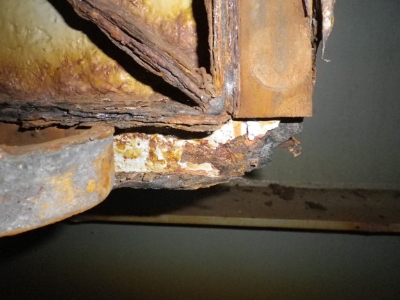
Cargo hold ventilation flap on a container vessel - not noted by Class
There appears to be a tendency in some countries (eg US or Italy) to hold classification societies liable for third party loss under certain very tightly limited conditions. But the same can seemingly not be said for flag State surveys* (see Reeman v Department for Transport) and does apparently not apply to criminal law.
A liability verdict for port State control inspection errors will probably be even harder to achieve. In the UK the complaining company would have to take the MCA to arbitration and the relevant statutory provision allows for an interpretative approach of wide discretion.
Criminal law seems to be a bit more straight forward. If a surveyor is negligent (be it because of an error of judgment, sloppiness or incompetency) they will under English law usually not be prosecuted because their action lacks a mental element (see below) as an essential ingredient of a criminal offence. That may be different in other countries (eg France) and is certainly different for the owner, operator, master and/or crew.
In jurisdictions with corporate manslaughter legislation a company and its representatives may in case of the death of a person have to face two trials. One for personal and another for corporate manslaughter.
Thus, it appears that there is an incentive for management to assure that the safety of the vessel complies with what an ordinary skilled manager would expect the standard to be.
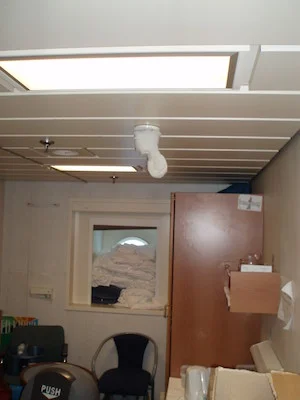
Smoke on the water - particularly when the ship burns down; "socked-up" smoke detector in crew meeting cabin on a passenger ship
Strict criminal liability
In countries with strict criminal liability for breaches of merchant shipping health and safety regulations (as in the UK), the occurrence of the violation establishes criminal liability. The incident alone, irrespective even of any direct participation of the person named in the statutory provision (i.e. company or master - not the surveyor), makes them criminally liable. In the UK the evidence of mens rea (a guilty mind or intent) is irrelevant and seen as prejudicial. Therefore, the prosecution must not even submit evidence of a person's guilty mind.
Theoretically every non-compliance with a statutory provision on board (eg the sock covering the smoke detector) establishes an offence. However, those breaches are usually not prosecuted as long as no damage, injury or loss of life results.
One may consider this to be part of a "managerial risk assessment"...what are the odds that something goes wrong and I get caught?
Even in cases of serious technical breaches with a high potential of "what if", the worst case scenario for a company (owner/operator) is usually a detention. A detention, irrespective of what it feels like, though, is not a penalty but an administrative measure.
However, if all else fails, you can still call me in to give you a hug...
*(yet? - because "the law is not ossified" as Lord Browne-Wilkinson said in White v Jones; see also a 2015 decision of the English High Court which went against Companies House; a member of staff had erroneously recorded a winding up order against the claimant's company which led to its bankruptcy; the judge held that the Registrar of Companies House owed a duty of care to ensure that the order is not registered against the wrong company; earlier in 1998 in Perrett v Collins, where a person was injured, the aircraft inspector working on behalf of a certification agency appointed by the CAA was also held to owe a duty of care because the public relies on the inspector exercising reasonable care).