
What to inspect?
During my years as port State control officer (PSCO), having to detain some 40 to 50 ships, I had ample opportunity to see and understand the systems of inspections.
Firstly, I can help you prepare for PSC inspections, can be there when you expect the PSCO to call (you may want to check out the Paris MOU risk calculator) and help you verify and discuss their findings. I can, of course, also assist you argue your case with the relevant PSCO or their head office.
Secondly, I can offer general ship, safety or cargo inspections.
Thirdly, I can attend any vessel you can provide access to and verify any damage which may have occurred to vessel or cargo.
Cracks in the system
Inspections, as I define them here, come in various different shapes or forms. There are, for example, inspections by ship personnel, company personnel, flag State inspectors, charterer inspectors or PSCOs. Sometimes inspections are planned and scheduled and at other times they come un-announced. Their basic difference to a survey is that other than internal (ship or company) inspections the owner did usually not ask for them but must accept them under statutory or contractual requirements. PSC inspections are also free of charge - as long as the vessel does not get detained.
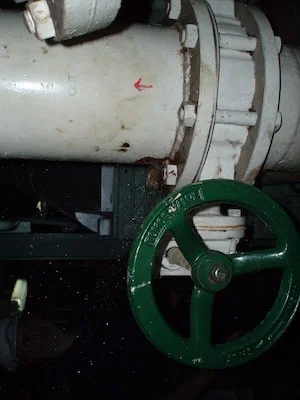
During inspections there is no limit to revelations - this, for example, is a hole in an overboard seawater cooling pipe
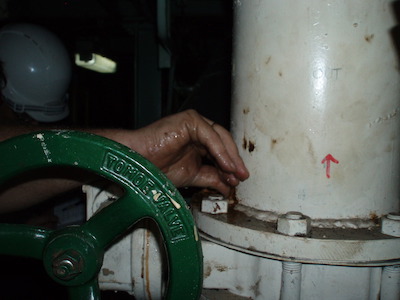
There is also no limit in temporary repair measures - some, however, have a rather short life
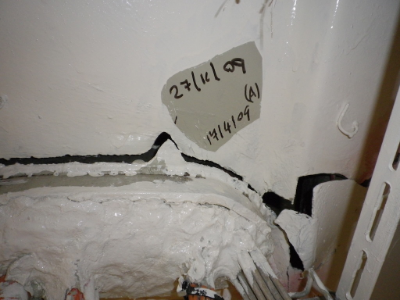
Crack in a class A0 bulkhead separating the fire locker from an accommodation corridor on a passenger vessel - tolerated by the flag State
It is obvious that internal inspections and their result are under the direct control of master and company. They, therefore, also have the initial control over what is recorded, reported and repaired. However, it would appear short-sighted to overlook repair requirements which may result in a detention when the PSCO calls.
In addition, it is always the master's call as to whether they think their ship is safe to sail. When it comes to the crunch the master and the DPA will be at the forefront of those having to explain why the vessel was not repaired. It is not only physically but also legally the master's and DPA's risk to set sail with an unseaworthy ship.
It does not require a lot of imagination to understand that a crack in an class A0 bulkhead of a fire locker will wake up any PSCO worth their salt. Or, worse, the crack could make the fire locker unusable in case of fire.
The apparent evidence also raises the question who knew about it and why had the gas-tight bulkhead between accommodation corridor and fire locker not been repaired? A considered bookkeeping approach was apparently applied when checking every six months - what actually, that the crack is still there...?
Rectifying an obvious error may not address the real problem. For instance, removing the rope (as seen in the photo) from a fire screen door may seem an appropriate quick and easy fix. However, a breach of the fire integrity of the vessel, whether due to laziness, sloppiness, a lack of knowledge or whatever may indicate a deeper problem. The fix may have to be more systemic - see also compliance.
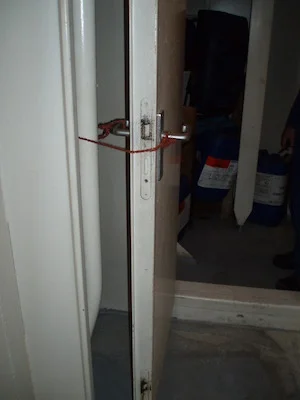
Fire screen door tied open
Examples from the cabinet of horrors
The two pictures below show the use of a thermal imaging camera which on a ship, for machinery or electrical installations may be used for fault finding. Particularly in large switchboards where faults are sometimes difficult to identify thermal imaging may save a lot of time and manpower. In the pictures you see that by manipulating the temperature range on a thermal imaging camera the displayed information changes significantly (they also show that the emissivity value for human skin was not set quite right as it should have been 0.98 or 0.99).
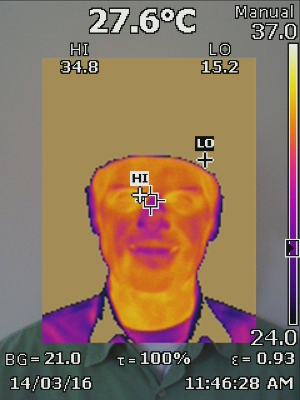
This is what my wife thinks I really look like...
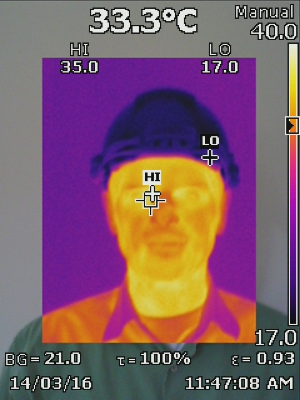
And this is how I got my head back - thanks to the hard hat!